Food
The Hand-Rolling Technique That Separates Fresh Pasta From the Rest
The hand-rolling technique that separates fresh pasta from the rest has nothing to do with a pasta machine. It all starts with how you work the dough by hand.
Now, a pasta maker can flatten things out just fine. But it can’t tell you if your fresh pasta dough needs more flour or a few extra minutes of rest. Your hands can feel that, though. And when you use a rolling pin, you naturally pick up on every little change in resistance and moisture as gluten develops.
That’s the kind of thing students learn at Fiore Restaurant during their hands-on pasta-making classes. The focus is always on technique first, then equipment.
In this article, we’ll cover how to knead, rest, and hand-roll homemade pasta for the right texture. We’ll also go over common mistakes and how to fix them along the way.
But before you can roll fresh pasta into thin, even sheets, you need to understand what makes the dough flexible enough to stretch.
How to Make Pasta Dough by Hand: Kneading, Gluten Development and Texture
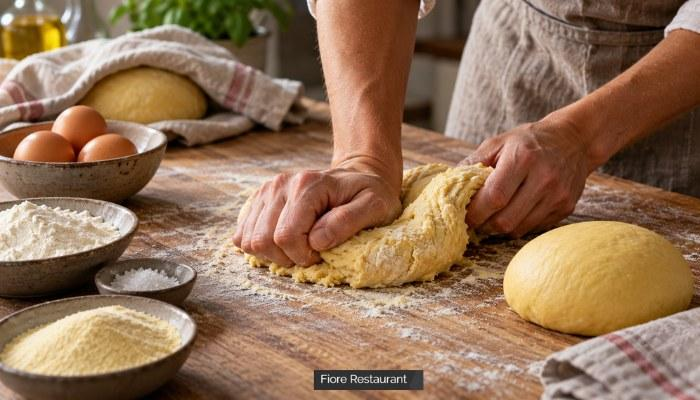
Good fresh pasta dough starts with your hands, not a stand mixer or a pasta maker. The way you knead, hydrate, and rest the dough is what decides whether it rolls out smoothly or tears apart on you.
So let’s walk through each step.
Choosing Flour and Eggs for Fresh Homemade Pasta
A basic fresh pasta recipe only needs flour, large eggs, and a pinch of salt. Most Italian kitchens reach for 00 flour because it’s ground ultra-fine, almost like baby powder. That fine texture means it absorbs water faster and produces a smoother, more pliable dough.
All-purpose flour works too, but it has a coarser grind and sits between 10 and 12% protein compared to 00 flour’s 12 to 13%. In practice, that means your dough will feel a little thicker and tougher under the rolling pin.
Then there’s semolina flour, which comes from durum wheat, a harder grain that grows mostly in southern Italy’s hot, dry climate. It’s traditionally used for hand-shaped pasta like orecchiette and cavatelli. You can also sprinkle a bit of it on your work surface to keep fresh pasta strands from sticking.
Regardless of which flour you choose, the dough’s texture is your best guide. Eggs and flour can absorb moisture differently with each batch, so exact measurements may need slight adjustments.
What you really want to aim for is a dough that feels firm, smooth, and just slightly tacky without clinging to your hands.
Why Kneading Creates the Texture of the Best Pasta
Gluten development is what gives fresh pasta its bite and stretch. Two proteins in flour, glutenin and gliadin, combine with water to form gluten. Kneading develops these proteins into a network that helps the dough hold together and stretch without tearing.
The motion itself is pretty simple. Push the dough forward with the heel of your hand, fold it back over itself, give it a quarter turn, and repeat. After about 8 to 10 minutes of this, the dough should go from shaggy and rough to smooth and elastic.
If you don’t knead enough, the dough will stay weak and tear when you try to roll it thin. But if you overdo it, the whole dough will turn stiff and can be difficult to stretch.
To check its texture, pinch off a small piece and gently pull it between your fingers. The dough should stretch into a thin sheet without snapping easily.
Resting Pasta Dough Before Rolling
After all that kneading, the gluten network needs time to relax. According to Chef Jacob Mendros of Prima Italian Steakhouse, 30 minutes of rest at room temperature is enough (though you can go up to an hour if you like). Skipping this step makes the dough tougher, more brittle, and prone to cracking when you roll it.
While the dough rests, wrap it in plastic wrap or cover it with a damp kitchen towel. This keeps the surface from drying out and forming a crust, which can make the dough harder to roll evenly.
When you’re ready to check, press a finger into the rested dough. If the indent slowly fills back in, it’s good to go. But if the dough still springs back hard when you try to roll it, give it another 10 to 15 minutes. A little patience here saves you from fighting the dough later on.
Once the dough is smooth and relaxed, the next step is making it into a thin, even sheet without tearing it.
The Fresh Pasta Technique: How to Make Fresh Pasta Without a Machine
You can make fresh pasta with just a rolling pin, a clean surface, and your hands. No pasta maker or KitchenAid attachment needed.
Here’s the full technique, from rolling to cooking.
Step-by-Step Hand-Rolling for Even Pasta Dough
Hand-rolling teaches you something a pasta machine simply can’t. You feel the pressure, resistance, and thickness as you work, so you catch thin spots before they tear. The slightly rougher surface of a hand-rolled sheet also helps sauce cling to each strand.
Follow these 5 steps to roll your dough into a thin, even sheet.
1. Prepare the Work Surface
Start by lightly dusting a clean wooden board or countertop with flour. You want just enough to keep the dough from grabbing the surface. Too much flour, though, will dry the dough out and make the final texture feel tough instead of tender.
2. Divide and Flatten
Next, cut your rested dough into 4 equal portions. Keep the unused pieces covered with plastic wrap or a damp kitchen towel so they don’t dry out while you work. Then take one portion and press it into a flat disc with your palm to give yourself a starting shape.
3. Roll From the Center Outward
Now place your rolling pin in the center of the disc and push outward with steady, even pressure. Work away from the middle in all directions so the dough stretches evenly, without one spot getting thinner than the rest.
4. Rotate and Reposition
After every few rolls, turn the dough a quarter rotation. This keeps it from sticking to the surface and also helps you catch uneven areas early on. If one section feels thicker than the others, just focus a bit more pressure there on your next pass.
5. Check the Thickness
For ribbon-style pasta shapes like fettuccine or tagliatelle, you want a sheet that’s slightly translucent when you hold it up to light. You should be able to see your hand’s shadow through it, but the dough shouldn’t be so fragile that it tears from its own weight.
Sure, a pasta machine can speed this process up. But rolling by hand shows you how the dough should feel.
How to Fix Pasta Dough That Sticks, Tears or Springs Back
Even experienced cooks run into trouble with fresh pasta dough. The good news is that most problems come down to moisture, gluten, or technique, and the fixes are usually pretty simple once you know what to look for.
Below is our quick troubleshooting guide:
- Dough Sticks to the Pin:Too much moisture in the dough or too little flour on your surface is usually the cause. Sprinkle a light dusting of semolina or all-purpose flour and keep rolling. Just add small amounts at a time so you don’t swing too far in the other direction.
- Dough Cracks or Tears:Dry dough, under-kneading, or aggressive stretching can all cause this. Try misting your hands lightly with water and gently working the moisture back in. Give it another 10 minutes of rest before you pick up the rolling pin again.
- Sheet Thickness Is Uneven:Rotating more frequently between rolls is the simplest correction here. Focus the rolling pin on the thicker areas while easing off the thinner spots, and the sheet will even out within a few passes.
- Dough Shrinks After Rolling:Tense gluten is pulling the sheet back into shape, and the only real fix is time. Cover it and wait 5 to 10 more minutes so the protein network has a chance to loosen up on its own.
- Dough Feels Stiff and Hard to Flatten:Sometimes the dough just needs more rest, or a tiny bit of water. Start with rest first because that solves it more often than not. Only add moisture if the texture stays rigid after a full 10-minute break.
We’ve learned that the biggest lesson with fresh pasta is to watch the dough and make small corrections as you go. Always remember, pasta making rewards attention more than perfection.
How to Cut, Make Ahead and Cook Fresh Pasta
Once your sheet is rolled to the right thickness, dust both sides lightly with flour. Then fold it loosely into thirds and use a sharp knife or pizza cutter to slice it into ribbons at your desired width.
Unfold the pasta strands gently, give them a shake, and lay them on a lightly floured baking sheet or a pasta drying rack.
When it comes to cooking, fresh pasta only needs about 2 to 4 minutes in a large pot of salted water, compared to 8 to 12 minutes for dried noodles. Start tasting the pasta after 90 seconds and drain it when it’s tender but still has a slight bite.
If you want to save some pasta for later, coil your pasta strands into small nests on a baking sheet and freeze them solid for about an hour. Once they’re firm, transfer them to an airtight container.
Worth knowing: Frozen pasta stays good for up to a month and cooks straight from the freezer.
Ready to Master the Basics of Fresh Pasta Making?
Good hand-rolled pasta comes down to three things: enough kneading to build gluten, enough rest to let it relax, and even rolling for a consistent thickness. A pasta machine can save you time, but it won’t teach you how the dough should feel at each stage. Only your hands can do that.
And honestly, the goal isn’t picture-perfect dough. It’s fresh pasta with an even bite when it hits the plate. That’s what traditional Italian recipes have always been about: learning through touch, patience, and practice.
It’s the same approach Fiore Restaurant takes in their hands-on pasta-making classes. You work with real dough, learn from experienced instructors, and walk away with skills you’ll use for years.
Want to learn homemade pasta from scratch the real way? Check out Fiore Restaurant’s classes and get your hands in the dough.
Ready to Visit Shukette?
230 9th Ave, Chelsea, NYC. Walk-ins welcome at the counter, reservations recommended for tables.
More From the Journal
Food
How Do Small Restaurants Make Food Photos and Videos Without a Photographer?
A restaurant photographer costs more than most independent kitchens spend on marketing in a month. A proper shoot means a stylist, a day of lost covers, and a set of images that look dated by the next menu change. Meanwhile the restaurant down the street posts three times a week and looks busier than it […]
Food
Gluten Free Bread That Doesn’t Taste Like Cardboard: A Beginner’s Guide
Ask anyone who has just switched to a gluten-free diet what they miss the most and you will find out that the answer will always be bread. Whether it’s a nice piece of toast, a yummy sandwich, a garlic bread after dinner, a lot of people eat a lot of bread on a daily […]